DISABILITY ADVOCACY AND SERVICES KENYA (DASK)
Position Article · 29 September 2026
Retire at 65: By Right, Not by Request
The Interior Ministry circular on Section 21(6) of the Persons with Disabilities Act, 2025, the questions it leaves open, and the workers it does not reach: persons with disabilities in the private sector.
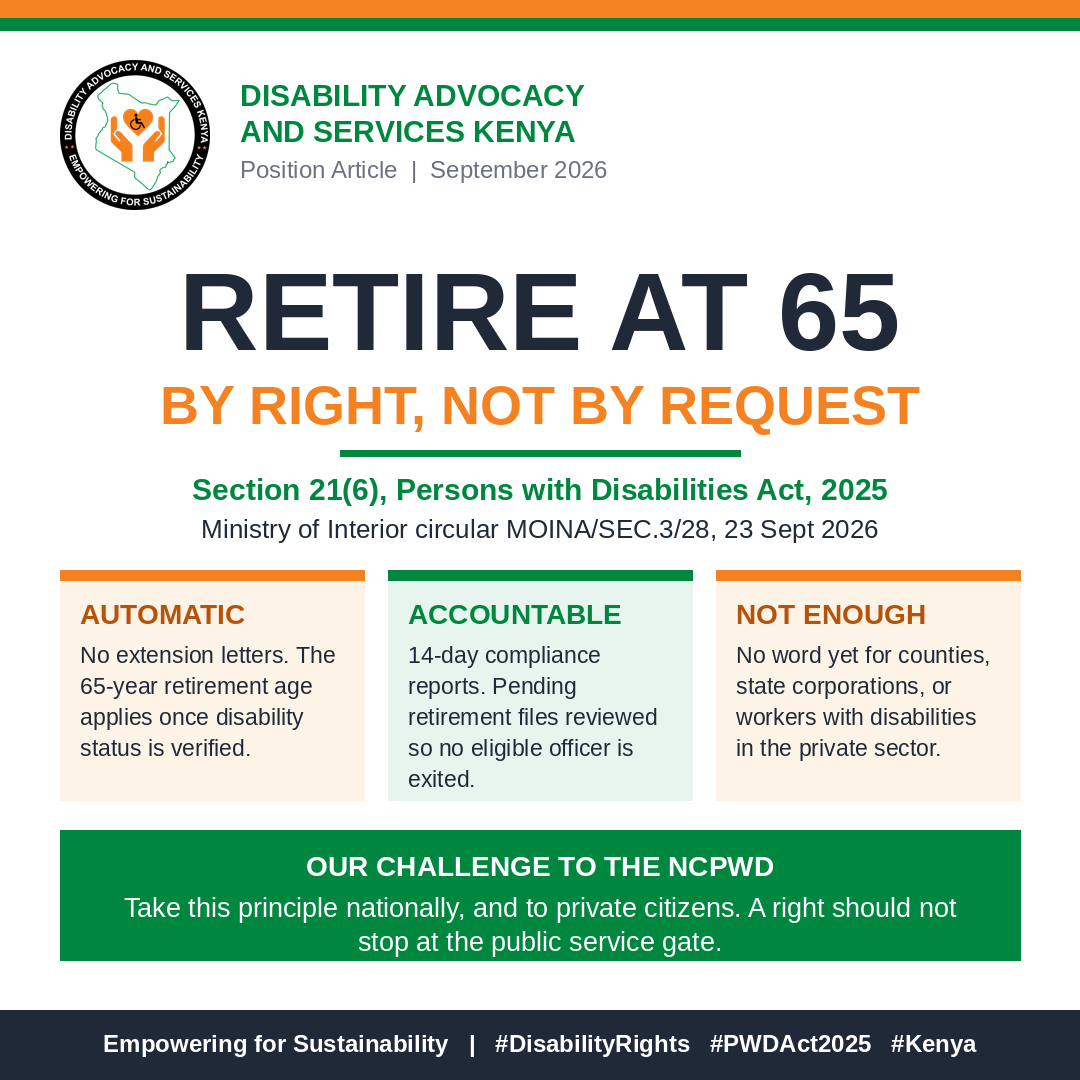
In briefOn 23 September 2026 the Ministry of Interior and National Administration (Ref: MOINA/SEC.3/28) told all County Commissioners to stop requiring public officers with disabilities to apply for extensions of service. Under Section 21(6) of the Act, the 65-year retirement age applies automatically once disability status is verified. DASK welcomes this, and asks what happens next, and for everyone the circular does not cover.
What the circular says
The circular responds to an advisory from the National Council for Persons with Disabilities (NCPWD, Ref: NCPWD/ADM/19 VOL. XII (85), 14 September 2026). The Council noted that public institutions still make officers with disabilities apply for extensions or obtain recommendation letters. The advisory’s position: this is a direct statutory entitlement, not a favour, and not conditional on approval or letters. It cites Articles 10, 27, 41, 54 and 232 of the Constitution.
| Direction | Requirement |
|---|---|
| 1. Stop extension requests | No extension applications, ministerial approval or NCPWD recommendation letters. |
| 2. Adjust records automatically | HR, pension and payroll officers set the 65-year retirement age once disability status is verified. |
| 3. Sensitize institutions | Institutional heads, Sub-County administration officers and HR staff briefed on Section 21. |
| 4. Audit and report | Review pending retirement files so no eligible officer is unlawfully exited; report within 14 days. |
A right that needs permission is not a right
Officers with disabilities have been made to prove, again and again, that they deserve what the law already gives them: applications, letters, waiting. The result was an entitlement that depended on whoever handled the file. The circular moves the burden from the officer to the institution.
The extra years matter. Many persons with disabilities start formal work later because of barriers in education and hiring. Their costs of living are higher, and a pension built on fewer years often cannot cover them. And being told to beg for a right is simply demeaning.
Where implementation can fail
Reach
County Commissioners head the national government administration. County governments, the Teachers Service Commission, the Judiciary, state corporations and universities have their own HR frameworks. Unless each is addressed, the entitlement will be applied unevenly.
Verification
The circular does not say who verifies disability status, how fast, or with what documents. Officers with non-visible disabilities and those who acquired a disability in service are most at risk of a new hurdle.
Officers already exited
The circular is silent on officers retired early after the Act came into force. They were the direct victims of the practice it condemns, and they need a clear answer on reinstatement, pension and arrears.
Enforcement and honesty of reporting
There is no stated consequence for non-compliance, and the 14-day report only helps if it is complete and public.
The questions DASK is asking
- Ministry of Interior: How will the circular reach county governments, the TSC, the Judiciary, state corporations and universities? Will the 14-day reports be published in consolidated form?
- Ministry of Interior: What follow-up will there be for any institution that keeps demanding extension letters?
- NCPWD: What exactly counts as verification of disability status, who does it, and within what time? How will non-visible and acquired disabilities be handled?
- NCPWD: Has the Council stopped issuing recommendation letters for this purpose? How many complaints about forced retirement has it received since the Act took effect?
- Public Service Commission, SRC and the State Department for the Public Service: Are HR policies and pension circulars being revised to match Section 21(6)? What redress is there for officers already retired early?
- County governments: Will each county issue its own circular aligning county HR practice with the Act?
- Pension bodies: How will contributions, benefits and payroll systems be adjusted for the extra years, and when?
- Officers with disabilities: Have you been asked for an extension letter? Has your retirement date been corrected? Tell us. Your experience is the evidence.
The forgotten majority: persons with disabilities in the private sector
The circular is written for public officers, which is its proper scope. But most working Kenyans, including most working Kenyans with disabilities, are not public officers. They work in banks, factories, farms, schools, hotels, shops and workshops, or run small enterprises in the informal economy. What is their fate?
In much of the private sector, retirement age is set by the employer’s policy, the employment contract or pension scheme rules. There is no circular telling private employers to stop demanding extension letters, and no obvious equivalent of Section 21(6). For many private employees with disabilities, the danger is not the retirement age but the road before it:
- Quiet exits. Restructuring, redundancy, “performance” concerns and non-renewal of contracts can remove employees whose disabilities an employer finds inconvenient, and proving discrimination is slow and costly.
- Denied accommodation. Inaccessible buildings, rigid schedules and missing assistive technology push capable people out or hold them back for years.
- Acquired disability. A worker who becomes disabled may be dismissed instead of supported back to work.
- Insecure contracts. Casual and outsourced work carries little protection and almost no pension.
- Retirement with no safety net. Many private and informal workers have no occupational pension. For a person with a disability, with higher costs and often lower lifetime earnings, that can mean dependence or destitution.
- Those who never get in. Barriers at school, in training, in recruitment and in transport keep many persons with disabilities out of formal work altogether.
Article 27 of the Constitution prohibits discrimination by any person, not only by the State. The private sector is not outside this framework.
A challenge to the National Council for Persons with Disabilities
The Council noticed that a right was being denied, and acted. DASK commends that. We now challenge it to carry the same principle across the whole country and to private citizens. We call on the NCPWD to:
- Take the advisory nationally to county governments, the TSC, the Judiciary, Parliament, state corporations, universities and every other public employer.
- Speak directly to private employers through the Federation of Kenya Employers, the Kenya Private Sector Alliance, professional bodies and trade unions, on non-discrimination in retention, redundancy and retirement, and on reasonable accommodation.
- Publish a verification protocol in accessible formats, covering non-visible and acquired disabilities.
- Open a fast, safe complaints channel for public and private employees, with feedback and protection from retaliation.
- Work with labour and pension institutions, including the labour ministry and inspectorate, the Retirement Benefits Authority and the NSSF, on retirement and social protection for workers with disabilities, including the informal and self-employed.
- Collect and publish data yearly on employment, contract type, exits and reasons in both sectors.
- Report on the five per cent principle in Article 54(2) and involve persons with disabilities in designing all of these systems.
- Report back within a set period, and invite civil society to review it.
The principleA person with a disability should not have to ask for a right the law gives them, whether they work for a ministry, a county, a bank, a farm or their own small business. What government does for its own officers, it should also require and support across the country.
What DASK will do
- Monitor compliance and collect accounts from officers with disabilities, and share what we find.
- Build Section 21(6) and the principle of automatic entitlement into our Training of Trainers manual and mainstreaming work.
- Guide individuals facing denied entitlements or forced exit to the right offices.
- Engage private employers on inclusive employment and fair exit.
- Follow up publicly on these questions until we have answers.
Conclusion
The circular is a good and necessary step. But justice that stops at the public service gate is only half of justice. A person with a disability who works for a private company, or for themselves, is no less a citizen and no less entitled to dignity, fair labour practices and equal protection of the law.
Retire at 65, by right, not by request. And let every worker with a disability, in every sector, be able to say the same.
Source: Ministry of Interior and National Administration circular Ref: MOINA/SEC.3/28, 23 September 2026, “Compliance with Section 21(6) of the Persons with Disabilities Act, 2025”, citing NCPWD advisory Ref: NCPWD/ADM/19 VOL. XII (85), 14 September 2026.
Descriptions of constitutional Articles and of private-sector practice are general; please read them alongside the Constitution and the Persons with Disabilities Act, 2025.
Disability Advocacy and Services Kenya · Empowering for Sustain